
Why the nervous system matters
Every second of your life, your body and mind are orchestrating an astonishing symphony. Your heart is beating, your lungs are drawing in oxygen, your muscles are adjusting your posture, and your thoughts are moving from one idea to the next. What makes all of this possible is one master system: the nervous system.
The nervous system is the great communicator. It gathers information from your senses, interprets it in your brain, and sends signals out to every organ and muscle. It allows you to move, think, feel, and respond to the world around you.
Read more on: Rewiring a Fatigued Nervous System: Hope for Those with ME/CFS
When it works well, you hardly notice it. But when something goes wrong, the effects can be overwhelming. Dizziness, weakness, memory problems, pain, fatigue, or loss of balance are just a few of the ways nervous system issues can show up. Sometimes these issues are caused by structural damage, but other times they are the result of functional disruption— when the system is intact, but not working properly.
Understanding this distinction is the first step to understanding your own health.
A guided tour of the nervous system
The nervous system is both simple and breathtakingly complex. To make sense of it, we can break it down into its main components.
The Central Nervous System (CNS)
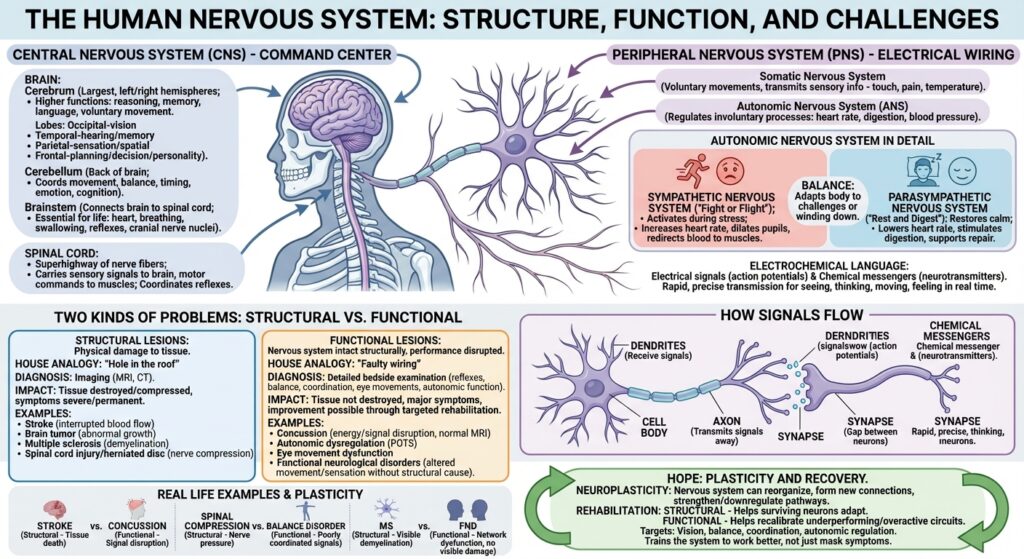
The CNS consists of the brain and spinal cord, protected by the skull and spine. This is the command center — where information is processed, decisions are made, and motor plans are sent out.
- The Brain
- Cerebrum: The largest part of the brain, divided into left and right hemispheres, it manages higher functions like reasoning, memory, language, and voluntary movement. Different lobes have specialized roles — the occipital lobe for vision, temporal lobe for hearing and memory, parietal lobe for sensation and spatial awareness, and frontal lobe for planning, decision-making, and personality.
- Cerebellum: Sitting at the back of the brain, the cerebellum coordinates movement, balance, and timing. It ensures your motions are smooth and accurate, and it also plays surprising roles in emotion and cognition.
- Brainstem: Connecting the brain to the spinal cord, the brainstem is essential for life. It regulates heart rate, breathing, swallowing, and reflexes, and also houses many cranial nerve nuclei.
- The Spinal Cord
The spinal cord is the superhighway of the nervous system. Bundles of nerve fibers carry sensory signals from the body up to the brain and motor commands from the brain down to the muscles. Reflexes are also coordinated at the spinal cord level, allowing you to react quickly before the brain even has time to process.
The Peripheral Nervous System (PNS)
Branching out from the spinal cord are peripheral nerves. These are the electrical wiring of the body, carrying information back and forth between the CNS and every muscle, joint, and organ.
The PNS has two main divisions:
- Somatic nervous system: Controls voluntary movements and transmits sensory information like touch, pain, and temperature.
- Autonomic nervous system (ANS): Regulates involuntary processes such as heart rate, digestion, and blood pressure.
The Autonomic Nervous System in detail
The ANS has two main branches that work in balance:
- Sympathetic nervous system (“fight or flight”): Activates the body during stress — increases heart rate, dilates pupils, and redirects blood to muscles.
- Parasympathetic nervous system (“rest and digest”): Restores calm — lowers heart rate, stimulates digestion, and supports repair.
This constant balancing act ensures that your body adapts appropriately whether you are facing a challenge or winding down to sleep.
How signals flow
The building blocks of the nervous system are specialized cells called neurons. A neuron has three main parts:
- Dendrites: Branches that receive incoming signals.
- Axon: A long extension that transmits signals away from the cell body.
- Synapse: The gap between neurons where communication happens.
Neurons communicate using both electrical signals (action potentials) and chemical messengers (neurotransmitters).
This electrochemical language allows neurons to transmit information rapidly and precisely. Networks of billions of neurons work together to allow you to see, think, move, and feel — all in real time.
Two kinds of problems: structural vs. functional
Now that we understand the basics of how the nervous system is built and how it communicates, let us look at what can go wrong.
Most people are familiar with structural lesions — visible damage to the nervous system. But there is another category, functional lesions, which can be just as life-altering even though they do not show up on a scan.
Structural lesions
A structural lesion is actual physical damage to nervous system tissue.
- Examples:
- Stroke (death of brain tissue due to interrupted blood flow).
- Brain tumor (abnormal growth pressing on structures).
- Multiple sclerosis (immune attack leading to demyelination of nerve fibers).
- Spinal cord injury or herniated disc compressing a nerve root.
- How they are diagnosed: Imaging such as MRI or CT usually reveals the problem.
- Impact: Because tissue is destroyed or compressed, symptoms may be severe and permanent, depending on the extent of damage.
Functional lesions
A functional lesion occurs when the nervous system is intact structurally, but its performance is disrupted.
- Examples:
- A concussion that leaves a person with dizziness and concentration problems, even though their MRI looks normal.
- Autonomic dysregulation after a viral illness, such as postural orthostatic tachycardia syndrome (POTS).
- Eye movement dysfunction leading to visual motion sensitivity.
- Functional neurological disorders where movement or sensation is altered without a structural cause.
- How they are diagnosed: Through detailed bedside examination — testing reflexes, balance, coordination, eye movements, and autonomic function.
- Impact: These conditions can cause major symptoms, but because the tissue itself is not destroyed, improvement is often possible through targeted rehabilitation.
Why the distinction matters
Think of your nervous system like a house.
- A structural lesion is like a hole in the roof. The only way to fix it is through repair or replacement — you need new shingles.
- A functional lesion is like faulty wiring. The structure of the house is fine, but the circuits are misfiring. What you need is rewiring and recalibration, not a construction crew.
Both problems are real, and both require different solutions. Recognizing whether a problem is structural or functional ensures that patients receive the right kind of care.
Examples in real life
- Stroke vs. concussion
- Stroke: Brain tissue is destroyed by lack of blood flow — a structural lesion.
- Concussion: Neurons are disrupted in how they metabolize energy and transmit signals — a functional lesion.
- Spinal cord compression vs. balance disorder
- Compression: A tumor or disc presses on nerves, damaging them structurally.
- Balance disorder: The vestibular system may be intact but sending poorly coordinated signals, leading to dizziness or vertigo — a functional lesion.
- Multiple sclerosis vs. functional neurological disorder
- MS: Physical demyelination is visible on MRI.
- FND: Motor or sensory symptoms are present, but no structural damage is seen — the problem lies in network dysfunction.
The hopeful message: Plasticity and recovery
Perhaps the most encouraging fact about the nervous system is its plasticity — its ability to change.
Neuroplasticity means the nervous system can reorganize itself by forming new connections, strengthening useful pathways, and downregulating unhelpful ones. This is the scientific foundation behind rehabilitation strategies for both structural and functional issues.
- After a structural lesion such as stroke, rehabilitation helps surviving neurons adapt and take over lost functions.
- After a functional lesion, rehabilitation helps recalibrate the circuits that are underperforming or overactive, often leading to substantial recovery.
This is why therapies targeting vision, balance, coordination, and autonomic regulation can be so powerful. They do not just mask symptoms — they train the nervous system to work better.
Bringing it all together
Your nervous system is the most sophisticated communication system in existence. It coordinates thought, movement, sensation, and survival. Problems in this system fall into two broad categories:
- Structural lesions: physical damage visible on scans.
- Functional lesions: disruptions in performance that may not show up on imaging.
Both types of issues are real, both can have a major impact on daily life, and both can improve with the right kind of care. Understanding this distinction empowers patients to seek out not only medical treatment when needed, but also functional approaches that retrain the nervous system to perform more effectively.
If you or someone you love is suffering from symptoms that you cannot find answers for and you would like to learn how chiropractic neurology might be able to help, contact the team at Georgia Chiropractic Neurology Center today. We look forward to hearing from you.
Written by Sophie Hose, DC, MS, DACNB, CCSP
Peer-Reviewed References
- Kleim JA, Jones TA. Principles of experience-dependent neural plasticity: implications for rehabilitation after brain damage. J Speech Lang Hear Res. 2008;51(1):S225–S239.
- Schmahmann JD. The role of the cerebellum in cognition and emotion: personal reflections since 1982 on the dysmetria of thought hypothesis, and its historical evolution from theory to therapy. Neuropsychol Rev. 2010;20(3):236–260.
- Giza CC, Hovda DA. The new neurometabolic cascade of concussion. Neurosurgery. 2014;75(suppl_4):S24–S33.
- Hallett M. Functional (psychogenic) movement disorders – clinical presentations. Parkinsonism Relat Disord. 2016;22(Suppl 1):S149–S152.